When a Clock Reads 4.0 Seconds a Carts Velocity in the Positive X-direction Is 6.0 M/s
One-Dimensional Kinematics Review
Navigate to:
Review Session Habitation - Topic Listing
1D Kinematics - Home || Printable Version || Questions and Links
Answers to Questions: #1-7 || #eight-#28 || #29-#42 || #43-#50
Part C: Diagramming
29. On the diagrams below, construct a dot diagram representing the motion of an object with a ... .
- abiding rightward velocity
- rightward velocity and a rightward acceleration
- rightward velocity and a leftward acceleration
- rightward velocity, outset slow and constant, and then accelerating to a high speed
- rightward velocity, first decelerating from a high speed to a residue position, then maintaining the rest position, and finally accelerating at a lower rate than the initial deceleration.
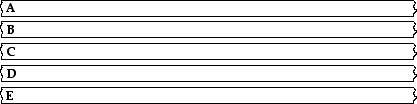
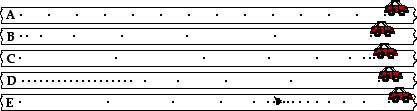
Answer: See diagram above; explanations are given below.
a. A constant velocity is depicted by dots which are spaced the same distance apart.
b. An object which is accelerating in the same management as the velocity (both are rightward in this case) is speeding up. And so equally y'all trace your centre from left to correct across the diagram (rightward), the dots should be spaced further and farther autonomously to indicate that the object is speeding up.
c. An object that moves rightward (i.e., rightward velocity) and accelerating leftwards must be slowing downward. So as y'all trace your eye from left to right across the diagram (rightward), the dots should be spaced closer and closer together to indicate that the object is slowing down.
d. The dots begin by being equally spaced (constant speed) and close together (slow); then the spacing betwixt dots get gradually further and further autonomously to indicated the speeding up nature of the motion.
e. The object is moving rightwards and then you will need to trace your centre from left to right across the diagram (rightward). As you do you will note that the dots become closer and closer to indicate that the object is slowing downwardly. And then the dots are piled onto the same location to point that the object is at rest. Finally, the dots are spread further and further apart; the rate at which the distance between dots is very gradual - consistent with the statement that the charge per unit of acceleration is less than the original rate of deceleration.
[ #29 | #30 | #31 | #32 | #33 | #34 | #35 | #36 | #37 | #38 | #39 | #forty | #41 | #42 ]
xxx. On a dot diagram, how does the motion of an object moving to the right and slowing downwardly differ from an object moving to the left and speeding up? Explicate.
Answer: At that place is no difference!
The ii diagrams would exist indistinguishable from each other as indicated by the post-obit two diagrams.

In that location are two ways to accelerate leftward; and regardless of how it happens, the oil drop trace would exist identical. A leftward acceleration is a leftward acceleration.
Part D: Kinematic Graphing
31. On the position-time graph beneath, sketch a plot representing the motion of an object which is ... . Label each line with the corresponding letter (e.chiliad., "a", "b", "c", etc.)
- at rest.
- moving in the positive direction with abiding speed
- moving in the negative direction and speeding upwardly
- moving in the positive direction and slowing down
- moving in the positive direction at a constant speed (slow) and then afterward fast at constant speed
- moving with a negative velocity and a negative acceleration
- moving with a negative velocity and a positive dispatch
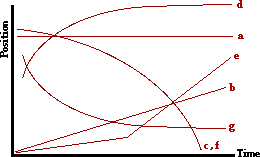
Answer: See diagram above; explanations are given below.
The governing principle in this problem is that the slope of a position-fourth dimension graph is equal to the velocity of the object.
a. An object at rest (5 = 0 one thousand/due south) is represented by a line with 0 slope (horizontal line).
b. An object with a constant, positive velocity is represented by a straight line (constant slope) which slopes upward (positive slope).
c. An object moving in the - management and speeding up is represented past a line which slopes downward (- slope) and increases its steepness (increasing slope).
d. An object moving in the + direction and slowing downwards is represented by a line which slopes upward (+ slope) and increases its steepness (increasing gradient).
e. An object moving in the positive management at constant speed would exist represented by a straight diagonal line (constant speed) which slopes upward (+ velocity). So in this case, there will be ii straight diagonal lines; the second line will gradient more than than the first line.
f. An object moving in the negative direction with negative acceleration is speeding up (since the a vector is in the same management as the movement). And so on a p-t graph, this object will be represented by a line which slopes downwards (- velocity) and increases its gradient over fourth dimension (speeding upward).
g. An object moving in the negative management with positive acceleration is slowing downwards (since the a vector is in the opposite direction every bit the motion). Then on a p-t graph, this object will be represented by a line which slopes downwardly (- velocity) and levels off or becomes more horizontal over time (slowing downwards).
32. On the velocity-fourth dimension graph below, sketch a plot representing the motion of an object which is ... . Label each line with the corresponding letter (eastward.g., "a", "b", "c", etc.)
- at rest
- moving in the positive management at constant speed
- moving in the negative management from slow to fast
- moving in the negative direction from fast to slow
- moving with a positive velocity and a positive acceleration
- moving with a positive velocity and a negative acceleration
- moving with a positive velocity at constant speed and and so decelerating to a rest position
- moving in the positive direction while slowing down, changing directions and moving in the negative directions while speeding up
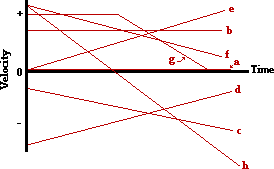
Answer: See diagram above; explanations are given below.
The governing principle in this trouble is that the slope of a velocity-time graph is equal to the acceleration of the object. Furthermore, a negative velocity would be a line plotted in the negative region of the graph; a positive velocity would exist a line plotted in the positive region of the graph.
a. An object at rest (v = 0 grand/s) is represented by a line located on the time axis (where v = 0 m/due south).
b. An object moving in the positive direction at abiding speed will exist represented on a v-t graph by a horizontal line (slope = a = 0 g/s/s) positioned in the + velocity region.
c. An object moving in the negative management and speeding up volition be represented on a 5-t graph by a sloped line located in the - velocity region. Since such an object has a - dispatch, the line volition slope downwards (- dispatch).
d. An object moving in the negative direction and slowing downwards volition exist represented on a five-t graph past a sloped line located in the - velocity region. Such an object has a positive acceleration (since information technology is slowing downwardly, the a vector will be in the opposite management of the motion). The + acceleration would exist consistent with a line that slopes upwards.
eastward. An object moving with a + velocity and a + dispatch would be represented on a five-t graph by a sloped line located in the + velocity region. The + dispatch would be consistent with a line that slopes upward.
f. An object moving with a + velocity and a - acceleration would be represented on a 5-t graph by a sloped line located in the + velocity region. The - acceleration would be consistent with a line that slopes downwards.
1000. An object moving with a constant + velocity would be represented on a v-t graph by a horizontal line (slope = a = 0 chiliad/s/s) located in the + velocity region. The slowing downward to rest portion of the graph would exist represented by a line which slopes downwardly (- acceleration) towards the fourth dimension centrality.
33. Consider the position-time plots beneath. Sketch the shape of the respective velocity-time graphs.
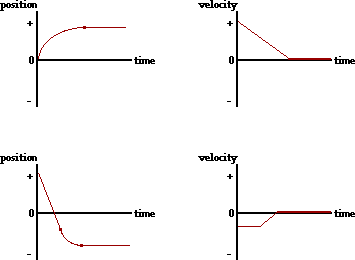
Reply: See diagram above; explanations are given below.
In the top graph, the object moves in the + management with an acceleration from fast to tedious until it finally stops. Then the object remains at remainder. This means there is a positive velocity and a negative dispatch; the last velocity of the object is 0 chiliad/s. So on a v-t graph, the line needs to be in the +velocity region and the gradient needs to be - (for a negative dispatch). The line should end on the v=0 m/south axis (corresponding to its last rest position).
In the bottom graph, the object is moving in the - direction with a constant speed. It then gradually slows downwardly until it stops; it then remains at remainder. So on a v-t graph, there should exist a horizontal line (a=0 m/s/s) in the -velocity region of the graph. Then the line should slope upwardly (for the + acceleration that is characteristic of objects moving in the - direction and slowing down). The line should end on the v=0 m/southward axis (corresponding to its final residue position).
34. Consider the velocity-time plots below. Sketch the shape of the corresponding position-fourth dimension graphs.
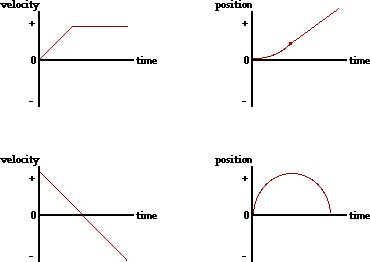
Answer: Encounter diagram in a higher place; explanations are given beneath.
In the top graph, the object moves in the + management with an dispatch from slow to fast. And so the object maintains a constant speed past walking in the same direction (+ direction). On a p-t graph, this would correspond to a line with positive slope (for moving in the + direction) which eventually straightens out into a diagonal line with constant slope (abiding speed) in the positive direction (positive velocity).
In the bottom graph, the object is moving in the + direction and slowing down from a high speed to a slow speed until it finally changes management; the object then moves in the - management and speeds upward. On a p-t graph, this would correspond to a line with positive slope (for moving in the + direction) which gradually levels off to a horizontal (for slowing downwardly); and so the line begins to slope downwards (for moving in the - management) and gradually becomes steeper and steeper (for speeding up).
The velocity-time graph beneath depicts the motion of an automobile every bit information technology moves through Glenview during rush hour traffic. Use the graph to answer questions #35 - #39.
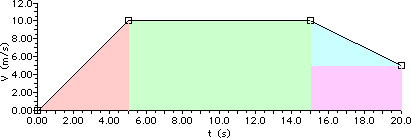
35. Determine the displacement of the car during the following intervals of time. PSYW
Answer: Run across diagram in a higher place and calculations below.
Use area calculations to determine the displacement of the object.
| | | |
| Area of the pinkish triangle: A = 0.v*b*h A = 0.v*(5 south)*(10 m/s) A = 25 m | Area of the green rectangle: A = b*h A = (ten south)*(10 m/s) A = 100 m | Area of the bluish triangle plus purple rectangle: A = 0.5*b1*h1 + bii*hii A = 0.5*(5 south)*(v yard/s) + (5 s)*(5 grand/s) A = 12.5 chiliad + 25 m A = 37.5 one thousand |
36.
Determine the velocity of the motorcar at the following instant(s) in time.
Reply: See calculations beneath.
It is a velocity graph; and so simply read the velocity values off the graph.
| | | |
| | 5 = 10.0 m/s | |
[ #29 | #30 | #31 | #32 | #33 | #34 | #35 | #36 | #37 | #38 | #39 | #40 | #41 | #42 ]
37.
Make up one's mind the dispatch of the car during the following intervals of fourth dimension.
Respond: See calculations beneath.
Do gradient calculations to determine the acceleration. Slope is rise/run.
| | | |
| a = (10 one thousand/s)/(5 s) a = 2.0 m/south/s | a = gradient = ascent/run a = (0 m/s)/(ten due south) a = 0.0 m/s/due south | a = slope = rise/run a = (-5 m/s)/(five southward) a = -1.0 m/south/s |
38.
Using consummate sentences and the linguistic communication of physics, describe the motion of the motorcar during the entire xx.0 seconds. Explicitly depict any changes in speed or management which might occur; identify intervals of time for which the motorcar is at rest, the automobile is moving with constant speed, or the automobile is accelerating.
Reply:
During the commencement 5 seconds, the car is moving with a + velocity and a + acceleration, increasing its speed from slow to fast. From 5 s to 15 due south, the machine is moving with a constant speed and a zippo dispatch. From 15 s to twenty s, the auto is moving with a +velocity and a - dispatch, decreasing its speed from fast to ho-hum.
39.
Supposing the car has an oil leak, demonstrate your agreement of its motion by drawing an oil driblet diagram for the xx.0 seconds of motion. Divide the diagram into iii singled-out time intervals (0.0 - 5.0 seconds, 5.0 - fifteen.0 seconds, fifteen.0 - 20.0 seconds).
Answer: Encounter Diagram and caption beneath.
In the first five seconds, the object is speeding up so the spacing betwixt dots will gradually increment. In the next x seconds (5-fifteen due south) the object is maintaining a constant velocity so the spacing between dots remains the same. In the last 5 seconds (xv-twenty s) the object is slowing downwardly then the spacing between dots is gradually decreasing.

40. For the plots below, make up one's mind the velocity of the object ... .
| | | |
| | | |
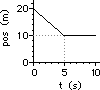
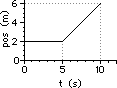
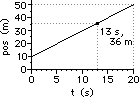
Reply: Run into explanations and calculations below.
For a position-time graph, the velocity is adamant from a slope calculation. So in each example, two points must be picked and gradient calculation must be performed.
a. Option the 2 points: (0 s, 20 grand) and (5 due south, 10 k)
slope = rise/run = (-x m)/(5 s) = -2.0 1000/due south
b. Pick the two points: (five s, ii m) and (10 s, half dozen 1000)
slope = rise/run = (four m)/(5 s) = +0.80 k/s
c. From 0 to 20 s, the slope is a constant value. So determining the slope at 13 seconds is as elementary every bit merely determining the slope of the line choosing any two points. So just selection the two points: (0 s, x one thousand) and (20 s, 50 thousand)
slope = ascension/run = (40 thou)/(20 s) = +2.0 m/due south
41. For the plots below, determine the acceleration of the object ... .
| | | |
| | | |
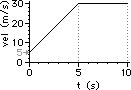
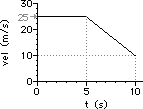
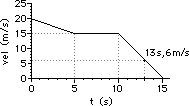
Answer: Run into explanations and calculations below.
For a velocity-time graph, the acceleration is determined from a slope calculation. So in each example, two points must be picked and slope calculation must be performed.
a. Pick the two points: (0.0 s, 5.0 grand/southward) and (5.0 due south, 30.0 m/s)
slope = rise/run = (25.0 m/s)/(5.0 s) = +5.0 m/southward2
b. Pick the 2 points: (v.0 s, 25.0 one thousand/s) and (x.0 s, x.0 m/s)
gradient = rising/run = (-15 thou/s)/(5.0 s) = -3.0 one thousand/s2
c. From x.0 to 15.0 south, the gradient is a abiding value. And then determining the gradient at 13 seconds is as simple as merely determining the slope of the line choosing any two points. So just pick the two points: (10.0 s, fifteen.0 m/s) and (fifteen.0 s, 0.0 m/s)
slope = ascent/run = (-fifteen.0 m/due south)/(v.0 s) = -three.0 one thousand/s
42. For the plots below, decide the displacement of the object ... .
| | | |
| | | |
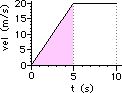
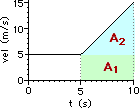
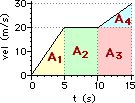
Reply: Run across explanations and calculations below.
For velocity-time graphs, the displacement of an object is found past computing the expanse betwixt the line and the time axis. The shape is typically a rectangle (area = base*summit), a triangle (expanse = 0.5*base*acme) or a trapezoid (which can typically be transformed into a rectangle and a triangle or the area tin can exist computed as 0.v*(hone + h2)*base).
a. Surface area = 0.5*base*height = 0.50*(5.0 s)*(20.0 m/southward) = 50. m
b. Area = A1 + A2 (see diagram) = (5.0 s)*(5.0 m/s) + 0.50*(five.0 south)*(10.0 m/s) = 25 m + 25 g = l. m
c. Expanse = Ai + A2 + Aiii + A4 (see diagram)
Area = 0.five*(5.0 due south)*(xx.0 m/southward) + (5.0 s)*(twenty.0 chiliad/s) + (v.0 s)*(xx.0 m/s) + 0.5*(five.0 s)*(10.0 m/southward)
Surface area = 50 m + 100 m + 100 m + 25 m = 275 m
Navigate to Answers for:
Review Session Domicile - Topic Listing
1D Kinematics - Domicile || Printable Version || Questions and Links
Answers to Questions: #one-7 || #8-#28 || #29-#42 || #43-#fifty
Y'all Might As well Like ...
Users of The Review Session are often looking for learning resources that provide them with practise and review opportunities that include congenital-in feedback and educational activity. If that is what you're looking for, then y'all might besides like the following:
- The Calculator Pad
The Calculator Pad includes physics give-and-take problems organized past topic. Each problem is accompanied by a popular-upwardly respond and an sound file that explains the details of how to approach and solve the problem. It's a perfect resource for those wishing to amend their problem-solving skills.
Visit: The Calculator Pad Home | Figurer Pad - Kinematics
- Minds On Physics the App Series
Minds On Physics the App ("MOP the App") is a series of interactive questioning modules for the pupil that is serious well-nigh improving their conceptual understanding of physics. Each module of the series covers a unlike topic and is farther broken down into sub-topics. A "MOP experience" will provide a learner with challenging questions, feedback, and question-specific help in the context of a game-like surroundings. It is available for phones, tablets, Chromebooks, and Macintosh computers. Information technology's a perfect resource for those wishing to refine their conceptual reasoning abilities. Part one of the series includes Kinematic Concepts and Kinematic Graphing.
Visit: MOP the App Abode || MOP the App - Function i
When a Clock Reads 4.0 Seconds a Carts Velocity in the Positive X-direction Is 6.0 M/s
Source: https://www.physicsclassroom.com/reviews/1D-Kinematics/Kinematics-Review-Answers-3
0 Response to "When a Clock Reads 4.0 Seconds a Carts Velocity in the Positive X-direction Is 6.0 M/s"
Post a Comment